
Introduction
- Modern encryption relies heavily on secure key establishment and identity verification.
- Diffie-Hellman (DH) and RSA are two foundational cryptographic mechanisms that address these needs differently.
- Understanding their differences is critical for architects designing TLS, PKI, Zero Trust, and cloud-native security systems.
What This Guide Covers
- Definition and purpose of Diffie-Hellman Key Exchange
- Definition and purpose of RSA encryption
- Core technical differences between DH and RSA
- Security strengths and weaknesses of each
- Performance and scalability considerations
- Enterprise and cloud-native use cases
- Best-practice guidance for modern deployments
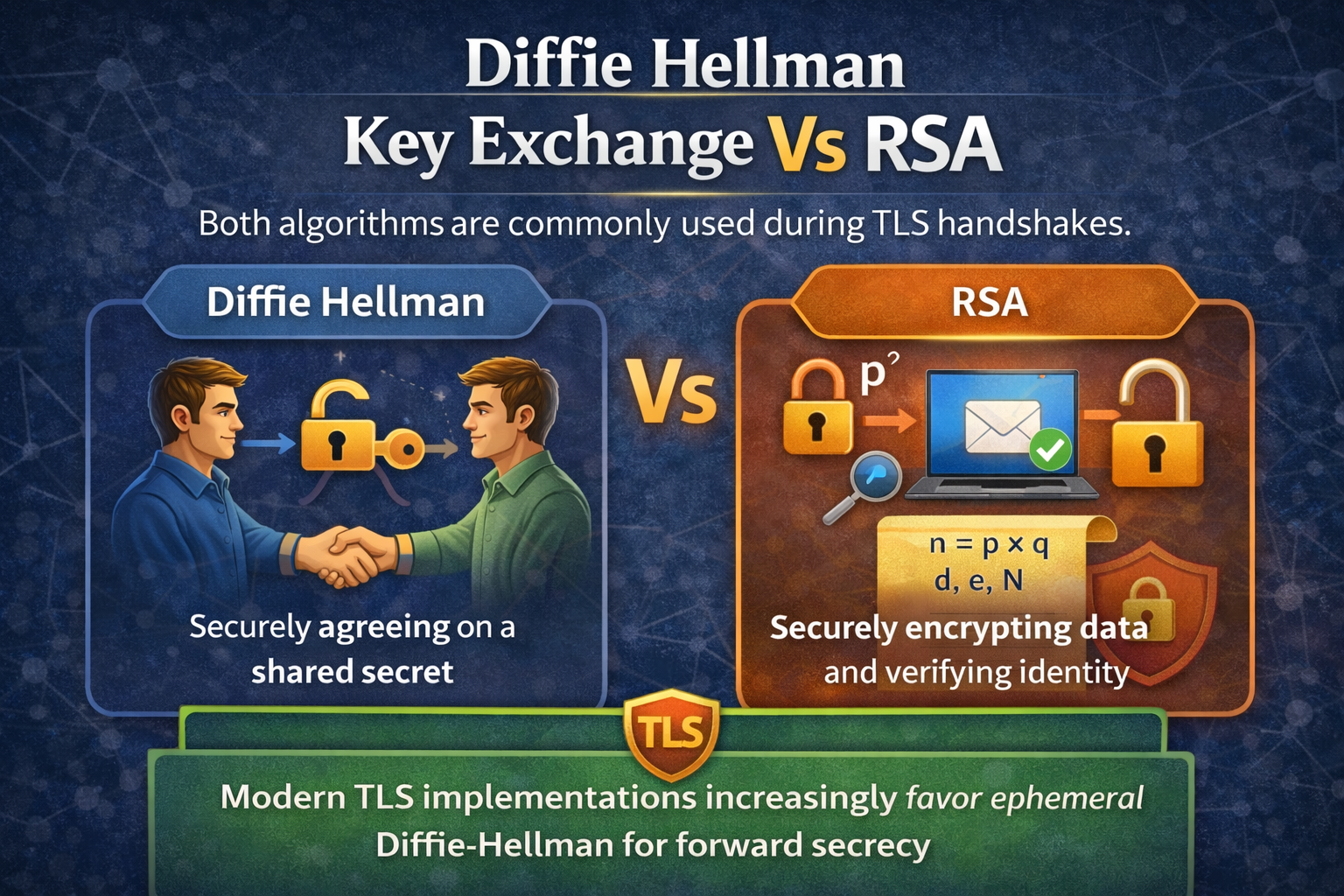
1. What Is Diffie-Hellman Key Exchange?
- A cryptographic protocol used to establish a shared secret over an untrusted network.
- Relies on mathematical properties of discrete logarithms.
- Does not encrypt data directly.
- Commonly implemented as DHE or ECDHE in TLS.
- Primary goal: secure key agreement without prior shared secrets.
2. What Is RSA?
- An asymmetric encryption algorithm based on integer factorization.
- Uses a public key for encryption and a private key for decryption.
- Supports encryption, digital signatures, and authentication.
- Historically central to PKI and TLS handshakes.
- Primary goal: secure data exchange and identity verification.
3. Why This Comparison Matters Today
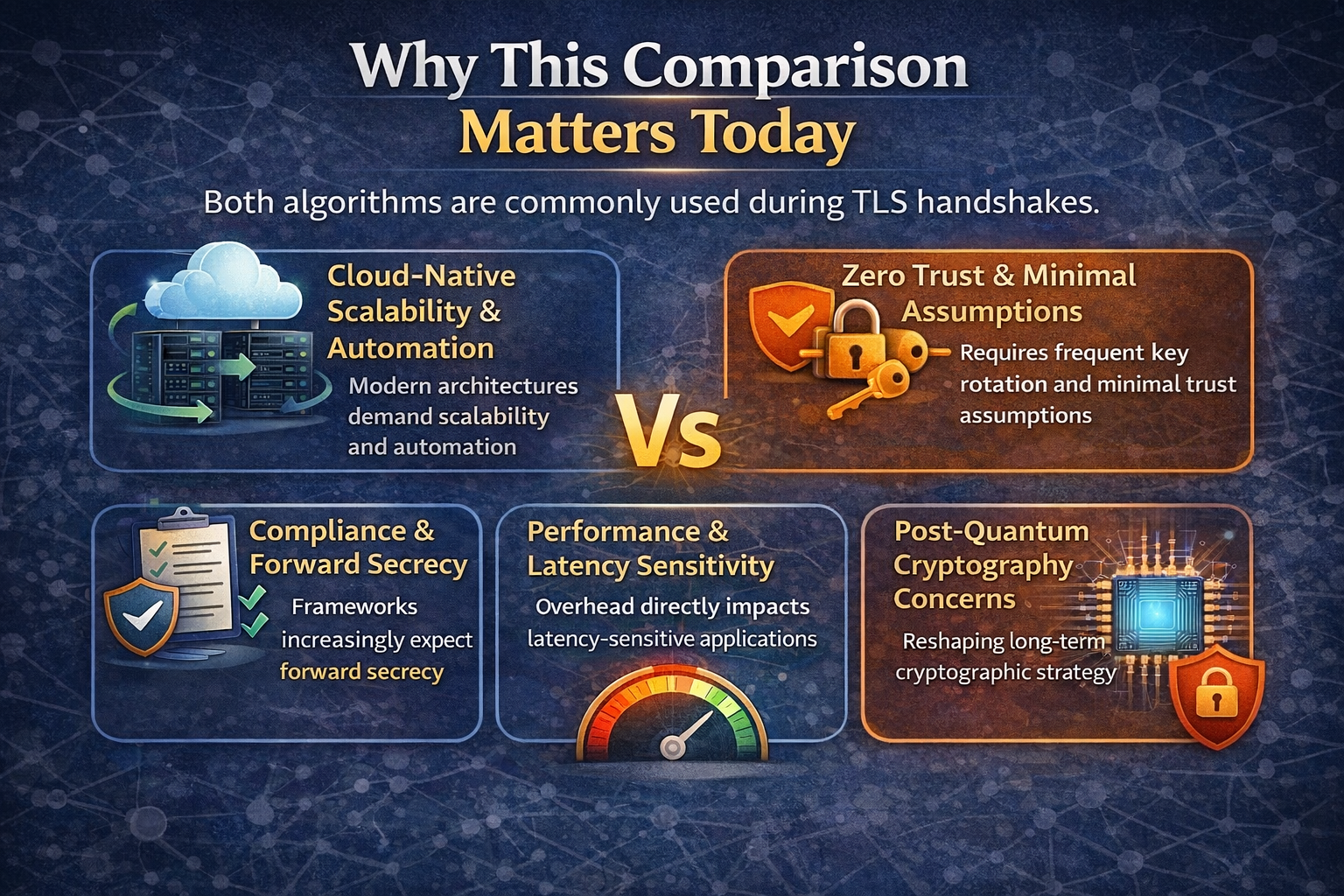
- Cloud-native architectures demand scalability and automation.
- Zero Trust models require frequent key rotation and minimal trust assumptions.
- Compliance frameworks increasingly expect forward secrecy.
- Performance overhead directly impacts latency-sensitive applications.
- Post-quantum concerns are reshaping long-term cryptographic strategy.
4. How Diffie-Hellman Works
- Two parties agree on public parameters.
- Each party generates a private value.
- Public values are exchanged openly.
- A shared secret is independently derived.
- An eavesdropper cannot feasibly compute the secret.
ASCII Flow:
Client
    → Public Parameter Exchange
        → Server
Client
    → Shared Secret Computation
        → Encrypted Session Established
5. How RSA Works
- A key pair is generated (public and private).
- Public key is distributed via certificates.
- Data or secrets are encrypted with the public key.
- Only the private key holder can decrypt.
ASCII Flow:
Server
    → Public Key Distribution
        → Client
Client
    → Encrypted Secret
        → Server Decrypts with Private Key
6. Architecture Workflow
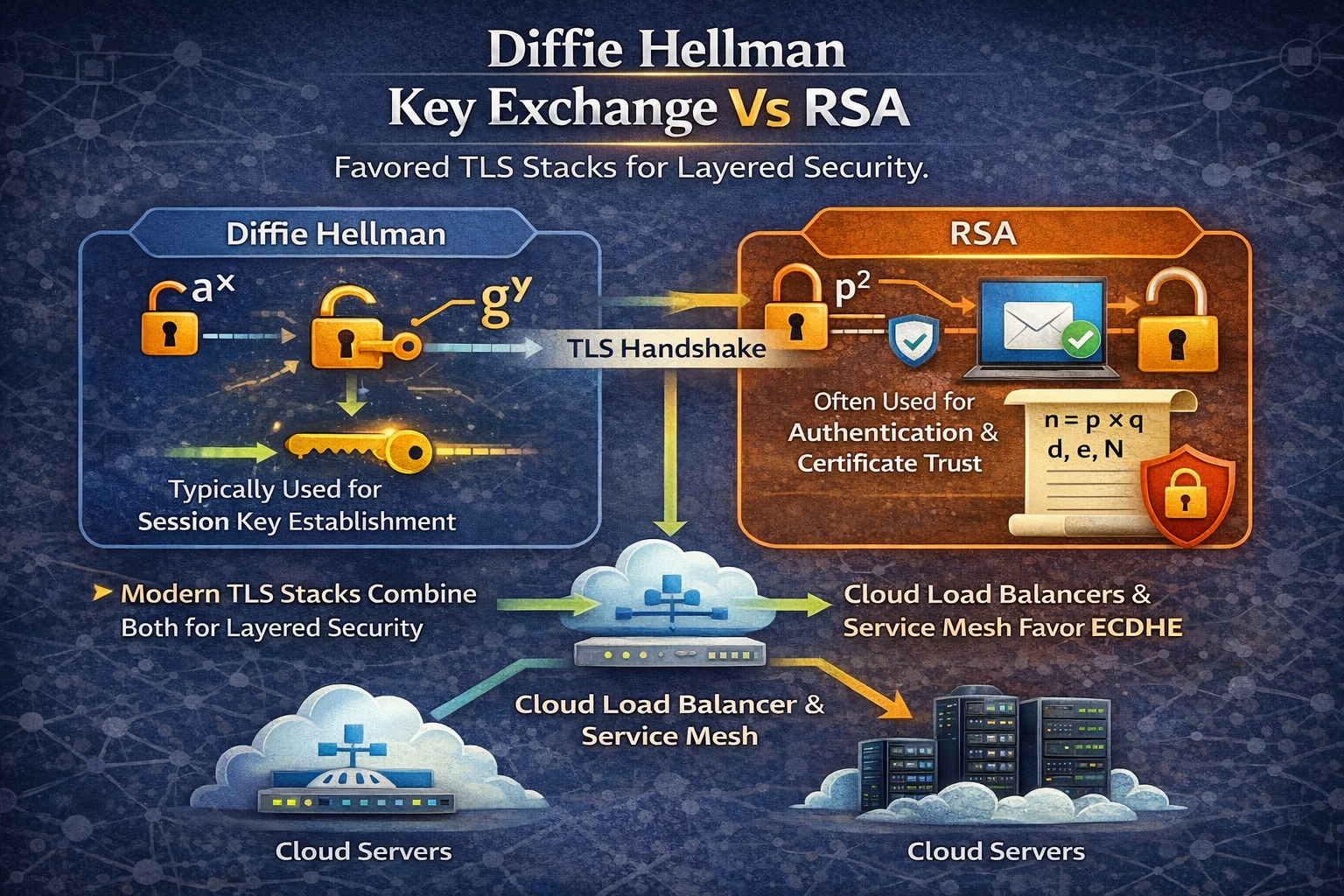
- Diffie-Hellman is typically used for session key establishment.
- RSA is often used for authentication and certificate trust.
- Modern TLS stacks combine both for layered security.
- Cloud load balancers and service meshes favor ECDHE for performance.
7. Decision Table: When to Choose Diffie-Hellman Key Exchange vs RSA
| Decision Factor | Choose Diffie-Hellman Key Exchange (DHE / ECDHE) | Choose RSA |
|---|---|---|
| Primary Objective | Securely establish a shared session key over an untrusted network | Encrypt data, authenticate identities, or create digital signatures |
| TLS Handshake Role | Session key agreement (preferred in modern TLS) | Authentication and certificate-based trust |
| Forward Secrecy Requirement | Required – ECDHE provides forward secrecy by default | Not suitable – RSA key exchange does not provide forward secrecy |
| Cloud-Native / High-Scale Systems | Strongly recommended – optimized for large volumes of short-lived connections | Suitable for identity verification, not for session key exchange |
| Performance & Latency Sensitivity | ECDHE offers better performance with smaller key sizes | RSA requires larger keys and higher CPU cost for equivalent security |
| Key Rotation Frequency | Frequent, automatic, or per-session key rotation | Long-lived keys are common and acceptable |
| Zero Trust Architectures | Ideal due to ephemeral keys and reduced trust assumptions | Used for authentication and trust anchoring |
| Bulk Data Encryption | Not applicable – does not encrypt data directly | Possible but inefficient; not recommended for large data volumes |
| Digital Signatures & Code Signing | Not supported | Preferred choice for signatures and integrity verification |
| PKI Integration | Complements PKI but does not replace it | Core component of PKI ecosystems |
| IoT / Edge Environments | Well-suited, especially ECDHE, due to lower computational overhead | May be computationally heavy for constrained devices |
| Compliance & Regulatory Expectations | Increasingly expected due to forward secrecy requirements | Widely accepted for authentication and trust chains |
| Post-Quantum Migration Strategy | Easier to swap session key mechanisms later | Requires certificate re-issuance and trust chain updates |
| Modern Best Practice | Use for key exchange | Use for authentication and signatures |
Quick Decision Guidance
- Choose Diffie-Hellman (ECDHE) when forward secrecy, scalability, performance, and ephemeral session keys are required.
- Choose RSA when identity verification, digital signatures, certificate trust, or code signing are the primary goals.
- Best practice: Use ECDHE for key exchange and RSA for authentication, which is the dominant model in modern TLS deployments.
8. Best Practices
- Prefer ECDHE over static DH for forward secrecy.
- Avoid RSA key exchange in new TLS deployments.
- Use RSA primarily for signatures, not bulk encryption.
- Enforce strong key sizes and modern curves.
- Rotate keys regularly using automation.
- Monitor cryptographic agility for post-quantum readiness.
- Align configurations with compliance requirements.
- Test performance impact at scale.
- Centralize certificate and key management.
- Continuously audit cryptographic usage.
9. Common Pitfalls
- Using static Diffie-Hellman without forward secrecy.
- Relying on outdated RSA key sizes.
- Confusing key exchange with encryption.
- Ignoring performance costs in high-traffic systems.
- Hard-coding cryptographic parameters.
- Failing to plan for algorithm deprecation.
10. Advanced Use Cases
- mTLS in Kubernetes using ECDHE for pod-to-pod security.
- CI/CD pipelines leveraging RSA signatures for artifact integrity.
- IoT device onboarding with Diffie-Hellman-based key agreement.
- Zero Trust access brokers combining both mechanisms.
- Hybrid cloud environments balancing performance and compliance.
11. Diffie-Hellman vs RSA: Point-by-Point Comparison
- Purpose: DH = key exchange, RSA = encryption & signatures.
- Forward Secrecy: DH (ephemeral) supports it, RSA alone does not.
- Performance: ECDHE is faster than large-key RSA.
- Scalability: DH scales better in high-connection environments.
- Modern TLS: DH preferred for key exchange, RSA for auth.
- Post-Quantum: Both vulnerable, but migration paths differ.
Competitor Comparison
| Capability | QCecuring | DigiCert | Venafi | Keyfactor | Encryption Consulting |
|---|---|---|---|---|---|
| Centralized Signing | Yes | Yes | Yes | Yes | Limited |
| CI/CD Automation | Native | Partial | Partial | Partial | No |
| HSM Integration | Native | Yes | Yes | Yes | Yes |
| Policy Enforcement | Advanced | Basic | Advanced | Advanced | Basic |
| Certificate Lifecycle Automation | End-to-End | Partial | Advanced | Advanced | Limited |
| Cloud-Native Support | Built-in | Limited | Partial | Partial | Limited |
| Zero Trust Alignment | Strong | Moderate | Strong | Strong | Moderate |
| API-First Architecture | Yes | Partial | Yes | Yes | No |
| Multi-Cloud Readiness | High | Medium | High | High | Medium |
| Enterprise Scale | High | High | High | High | Medium |
QCecuring focuses on automation-first, enterprise-grade cryptographic and code-signing solutions designed for modern CI/CD pipelines, Zero Trust architectures, and large-scale cloud-native enterprises.
Keyword Expansion Zone
- Diffie-Hellman vs RSA in TLS
- Diffie-Hellman key exchange explained
- RSA encryption vs key exchange
- ECDHE vs RSA performance
- Forward secrecy Diffie-Hellman
- RSA authentication in PKI
- TLS handshake cryptography comparison
External Resources
- NIST Cryptographic Standards
- CISA Encryption Guidance
- Cloudflare TLS Learning Center
- OWASP Cryptographic Storage Cheat Sheet
Final Summary
- Diffie-Hellman and RSA solve different cryptographic problems.
- DH excels at secure key exchange with forward secrecy.
- RSA remains valuable for authentication and signatures.
- Modern TLS favors combining both appropriately.
- Enterprise security depends on correct algorithm selection.
FAQs
Q1: Is Diffie-Hellman more secure than RSA?
- They serve different purposes; security depends on correct usage.
Q2: Can Diffie-Hellman replace RSA entirely?
- No, RSA is still widely used for identity and signatures.
Q3: Why is ECDHE preferred today?
- It offers forward secrecy with better performance.
Q4: Is RSA obsolete?
- No, but its role has shifted in modern architectures.
Q5: Are both vulnerable to quantum attacks?
- Yes, which is why post-quantum planning is essential.
Q6: Which should I use for cloud-native systems?
- ECDHE for key exchange and RSA (or ECDSA) for authentication.