
Explosive growth of machine identities
Containers, APIs, microservices, and workloads create thousands of identities that must be continuously managed.
Automate workload identity lifecycle, secure service-to-service communication, and enforce policy across dynamic cloud-native infrastructure.
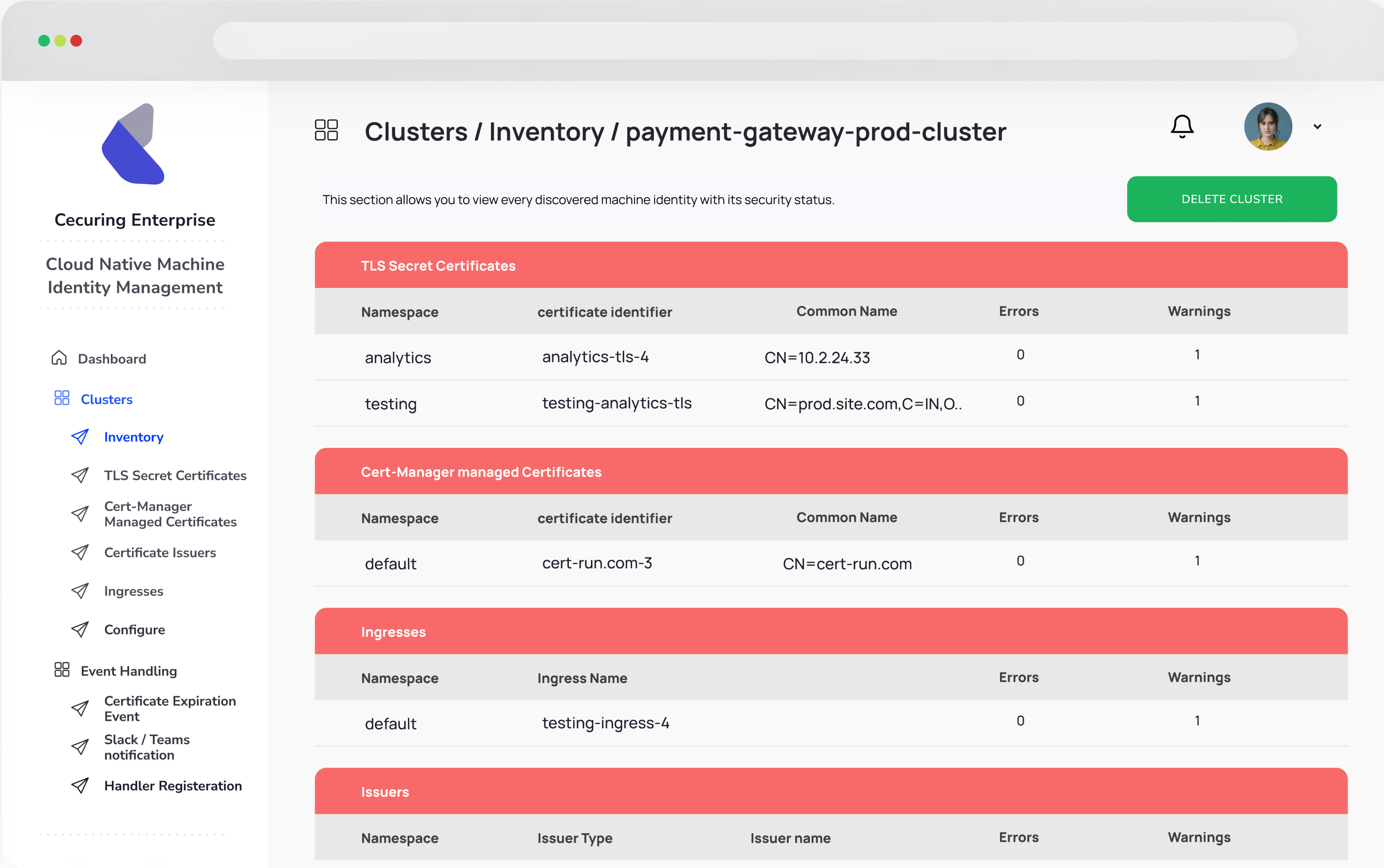
Modern cloud-native environments generate more machine identities than human identities. Without centralized lifecycle management, these identities become invisible, unmanaged, and vulnerable.
Containers, APIs, microservices, and workloads create thousands of identities that must be continuously managed.
Ephemeral infrastructure requires automated identity issuance and rotation that legacy tools cannot support.
Untracked identities, weak policies, and expired credentials create hidden attack surfaces across environments.
Different teams, clusters, platforms, and tooling choices create lifecycle inconsistency and governance drift.
QCecuring delivers end-to-end lifecycle management for machine identity across Kubernetes, cloud, and hybrid environments.
Automate identity issuance, renewal, rotation, and revocation for containers, services, and short-lived workloads.
Ensure every service interaction is authenticated, encrypted, and governed using strong workload identity controls.
Gain real-time visibility into workload identity posture, ownership, policy alignment, and risk across clusters and cloud environments.
Get a practical roadmap for implementing cloud-native identity lifecycle without slowing platform velocity.
Integrations
QCecuring integrates with the tools and platforms used in enterprise cloud-native environments.
Platform Capabilities
Continuously discover machine identities across Kubernetes, cloud, and hybrid environments.
Issue, renew, rotate, and revoke identities without manual intervention.
Define and enforce workload identity policies across teams, clusters, and services.
Use strong identity to secure communication between workloads, services, and internal APIs.
Track identity posture, lifecycle events, and policy alignment across dynamic infrastructure.
Prepare for certificate and algorithm changes across cloud-native workloads without losing control.
Use Cases
Enable secure communication and reliable identity lifecycle across modern distributed systems.
Ensure trusted identity between microservices in Kubernetes and distributed architectures.
Integrate identity lifecycle into deployment workflows for faster and safer releases.
Apply consistent policies across cloud, on-prem, and containerized workloads.
Use strong workload identity and policy enforcement to reduce lateral movement and unauthorized communication.
Standardize identity issuance and rotation so dynamic environments remain secure without slowing delivery.
Scale workload identity and service trust across cloud-native platforms using focused guides, deep dives, and deployment references.
Discover our industry-leading solutions, request a demo, or consult with our experts to strengthen your cryptographic operations.
How to secure workloads, automate identity lifecycle, and scale trust across distributed systems.
Machine identity has become a foundational security requirement in modern cloud-native environments. Containers, microservices, APIs, service meshes, and short-lived workloads all depend on trusted credentials to authenticate and communicate securely. As organizations scale Kubernetes and distributed architectures, the number of machine identities expands rapidly, often far beyond the visibility of traditional identity management approaches.
QCecuring Cloud-Native Machine Identity is designed to help security, platform, and infrastructure teams manage workload identity lifecycle across Kubernetes, cloud, and hybrid environments. The goal is not only to secure communication. It is to establish a repeatable, policy-driven operating model for workload trust, service authentication, and identity governance at enterprise scale.
In dynamic environments, workloads appear and disappear continuously. Applications are deployed more often, services are decomposed into microservices, and internal communication patterns become more distributed. This means the organization must manage a constantly shifting layer of non-human identities that enable trusted interaction between systems.
When workload identities are weak, inconsistent, or poorly governed, the result is not just operational overhead. The larger issue is trust failure. Services cannot securely authenticate one another, credentials may persist longer than they should, and security teams lose confidence in who or what is communicating across the environment. That makes machine identity a core concern for platform security, zero trust implementation, and operational resilience.
Many organizations still rely on identity practices designed for static infrastructure. Those approaches assume servers change slowly, credentials live for long periods, and manual processes can keep pace with operational demand. In cloud-native environments, those assumptions break down quickly.
Kubernetes clusters, ephemeral containers, and deployment pipelines require identity issuance and rotation to happen at machine speed. Manual ticketing, static credential placement, and inconsistent team-owned processes create delay and increase risk. Identities become overprovisioned, under-rotated, or disconnected from policy. As scale increases, visibility decreases.
A mature cloud-native machine identity program should provide continuous discovery, automated lifecycle workflows, centralized policy enforcement, and strong workload-level visibility. Security teams need to know where identities exist, how they are issued, how they are rotated, and which services depend on them. Platform teams need identity to become part of infrastructure operations instead of a separate, slow-moving control layer.
This means the right machine identity platform should support identity issuance, renewal, rotation, revocation, policy mapping, workload ownership, and evidence generation across distributed systems. It should also fit how modern teams work, integrating with Kubernetes, cloud platforms, secrets tooling, service mesh architectures, CI/CD systems, and observability layers.
One of the most important use cases for cloud-native machine identity is service-to-service trust. In a microservices environment, applications rely on internal communication across multiple components, clusters, and services. If those interactions are not strongly authenticated and governed, organizations increase the risk of impersonation, unauthorized communication, and lateral movement.
Workload identity helps enforce trusted service communication by ensuring that each service has a governed identity and that lifecycle rules are applied consistently. This supports stronger zero trust implementation because trust decisions can be made using policy, workload identity, and environment context rather than loose network assumptions alone.
Cloud-native identity must operate at the pace of modern deployment. That makes lifecycle automation essential. Without automation, platform teams are forced into operational bottlenecks where identity becomes an exception process instead of a built-in capability. With automation, identity issuance and rotation become repeatable infrastructure actions that support both security and delivery speed.
Automation also reduces credential persistence risk. Teams can support shorter-lived identities, tighter renewal windows, faster revocation, and better policy consistency. Instead of reacting to exceptions after systems break, organizations move toward proactive identity operations that are easier to govern and easier to scale.
One of the hardest parts of managing cloud-native machine identity is maintaining policy consistency across clusters, teams, and cloud platforms. Without centralized governance, different parts of the environment may adopt different issuance methods, validity standards, trust models, and operational shortcuts. This creates security drift and makes audits harder.
Policy-driven governance improves this by defining how workload identity should behave across the environment. It helps teams standardize approval models, validity expectations, workload ownership, secrets handling, trust boundaries, and lifecycle controls. Just as importantly, it creates visibility into where exceptions exist and which areas of the platform need improvement.
Most enterprises do not operate in a single pristine cloud-native stack. They run a mix of Kubernetes clusters, legacy platforms, cloud services, internal PKI, public trust dependencies, and on-prem systems. That hybrid reality means machine identity cannot be treated as a single-tool problem. It needs to function across operational boundaries and architectural layers.
A strong cloud-native machine identity approach should therefore support centralized governance while remaining flexible enough to work across hybrid infrastructure. This includes supporting private and public trust relationships, integrating with multiple operational systems, and allowing teams to adopt machine identity controls incrementally rather than through a disruptive platform rewrite.
Most organizations should roll out machine identity controls in phases. The first phase should focus on visibility: identify which workloads, services, and environments need trusted identity. The second phase should standardize issuance and rotation workflows for high-priority workloads. The third phase should extend lifecycle automation and reporting across more of the platform. Finally, teams should optimize governance and align workload identity with broader security architecture and compliance programs.
Enterprise buyers should expect more than basic credential issuance. A machine identity platform should improve security posture, support workload trust, reduce manual effort, and create a more stable operating model for platform teams. It should help teams manage growth without sacrificing control.
QCecuring Cloud-Native Machine Identity supports that direction by helping teams automate workload identity lifecycle, strengthen service-to-service trust, improve policy consistency, and gain better visibility into identity posture across modern environments. For organizations investing in cloud-native infrastructure, machine identity is no longer optional. It is part of the operational foundation required to scale securely.
Automate certificate discovery, renewal, deployment, and governance across enterprise infrastructure.
Learn more →Centralize certificate authority and PKI operations with managed lifecycle control.
Learn more →Control and secure SSH access across cloud, on-prem, and hybrid environments.
Learn more →Common questions from platform engineering, DevOps, and cloud security teams.
Cloud-native machine identity refers to the identities used by workloads, services, containers, and applications to authenticate and communicate securely in dynamic environments.
Yes. QCecuring is designed to support Kubernetes workloads and cloud-native identity lifecycle patterns.
It automates workload identity lifecycle, reduces credential sprawl, and strengthens service-to-service trust using centralized policy and visibility.
Yes. QCecuring supports hybrid and multi-cloud environments with centralized governance and flexible deployment models.
Machine identity helps enforce trusted communication between services and workloads, which is essential for zero trust architectures in dynamic environments.
Experience how our cryptographic solutions simplify, centralize, and automate identity management for your entire organization.
Get monthly insights on certificate management, post-quantum readiness, and enterprise security. No spam.
We respect your privacy. Unsubscribe anytime.