Expired certificates disrupt critical services
Customer-facing systems, APIs, internal tools, and infrastructure components fail when hidden or unmanaged certificates expire without timely renewal.
Discover, automate, and govern SSL/TLS certificates across cloud, containers, and infrastructure. Eliminate outages, enforce policy, and scale machine identity operations with QCecuring.
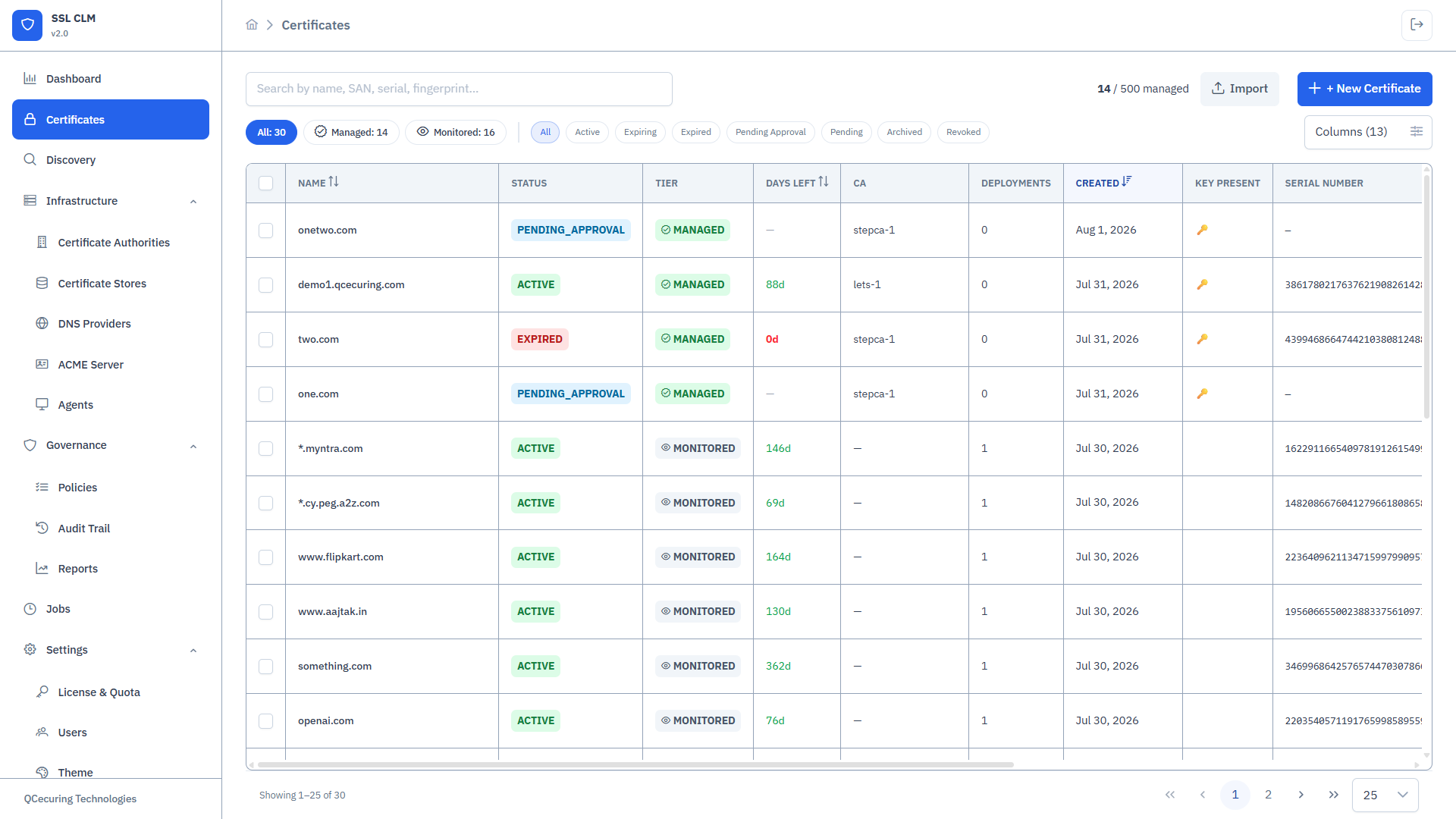
Product Demo
See how QCecuring automates certificate discovery, issuance, renewal, and revocation across your entire infrastructure.
Modern enterprises manage thousands to millions of certificates across cloud, on-prem, APIs, containers, and internal applications. Manual processes cannot scale, leading to avoidable outages, weak governance, and operational inefficiency.
Customer-facing systems, APIs, internal tools, and infrastructure components fail when hidden or unmanaged certificates expire without timely renewal.
Different teams, consoles, and environments create inconsistent inventory, unclear accountability, and incomplete lifecycle coverage.
Ticket-based issuance and renewal processes are too slow, too fragile, and too dependent on tribal knowledge to support enterprise scale.
Without centralized policy enforcement, organizations struggle to standardize key strength, certificate validity, algorithm usage, and lifecycle evidence.
Architecture
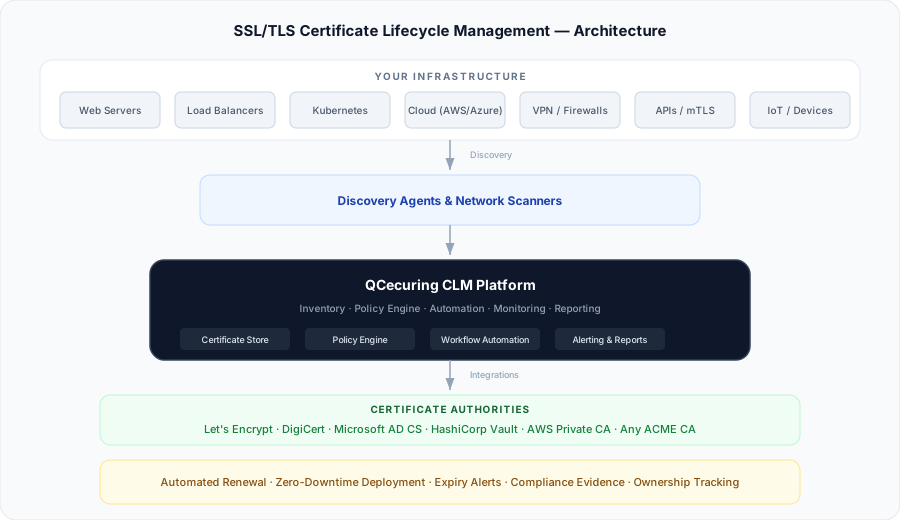
QCecuring gives security, PKI, platform, and infrastructure teams a centralized operating layer for certificate discovery, issuance, renewal, deployment, governance, and reporting.
Discover certificates across hybrid infrastructure, public and private CAs, cloud workloads, containers, load balancers, and application environments to build a trusted source of record.
Replace manual certificate workflows with policy-driven issuance, proactive renewal, approval handling, and deployment integration across enterprise systems.
Manage certificate operations across internal PKI, public CAs, and cloud-native issuance workflows while enforcing consistent policy and lifecycle standards.
Get a practical architecture walkthrough and phased deployment plan tailored to your infrastructure and risk profile.
Calculate your outage risk, wasted labor hours, and potential savings with our interactive ROI calculator.
Integrations
QCecuring fits into enterprise architectures so teams can modernize certificate operations without disruptive redesign or forced replacement of existing systems.
Platform Capabilities
Continuously discover, classify, and monitor certificates across cloud, on-prem, and hybrid environments.
Automate issuance, renewal, rotation, revocation, and deployment to reduce manual effort and outage risk.
Support public and private certificate authorities through a unified operational model.
Define and enforce rules for key algorithms, validity periods, access, approvals, and deployment standards.
Capture lifecycle actions, approval trails, and ownership data to improve compliance readiness.
Prepare for shorter certificate lifetimes, algorithm transitions, and future cryptographic change with better visibility and automation.
Use Cases
Designed for teams responsible for resilience, governance, compliance, and secure service delivery.
Use continuous monitoring and automated renewals to remove expiry-driven incidents from critical services.
Centralize lifecycle governance while continuing to support internal PKI, public CAs, and cloud-specific trust models.
Discover inherited certificates, normalize ownership, and apply consistent lifecycle controls across merged environments.
Execute broad algorithm and policy transitions faster with stronger inventory, ownership, and automation.
Integrate certificate operations into deployment pipelines and infrastructure workflows without increasing manual overhead.
Produce lifecycle evidence, ownership traceability, and policy enforcement records for internal and external review.
Boost your certificate and machine identity operations with practical guides, deep dives, and implementation references.
Discover our industry-leading solutions, request a demo, or consult with our experts to strengthen your cryptographic operations.
How security, PKI, platform, and infrastructure teams can reduce outages, improve governance, and scale machine identity operations across hybrid environments.
Certificate lifecycle management has become a core resilience function for modern enterprises. Certificates now secure customer-facing applications, internal services, APIs, service meshes, containers, cloud workloads, devices, and automated machine-to-machine communication. As certificate volumes grow, manual processes become a structural risk. Teams that still depend on spreadsheets, inbox reminders, isolated CA consoles, or ad hoc ownership models often discover issues only when a certificate is close to expiry or after a service has already failed.
QCecuring Certificate Lifecycle Management is designed to centralize certificate discovery, inventory, issuance, renewal, deployment, governance, and reporting across public and private certificate authorities. The objective is not only operational efficiency. The larger goal is to improve uptime, reduce hidden machine identity risk, and create a certificate operating model that can support enterprise scale.
In large organizations, certificates are no longer managed only by a small PKI team. They are requested, deployed, and consumed by infrastructure teams, security teams, DevOps teams, application owners, cloud teams, and external service operators. That distribution creates scale, but it also creates fragmentation. When there is no shared inventory or policy layer, organizations lose visibility into what certificates exist, where they are deployed, who owns them, which CA issued them, and which services would be affected by an expiry or misconfiguration.
This is why certificate lifecycle management should be treated as both a security discipline and an availability discipline. Expired or mismanaged certificates can interrupt production traffic, break integrations, delay releases, trigger emergency remediation, and increase audit burden. A mature lifecycle program helps reduce these risks by making certificate operations predictable, measurable, and automatable.
Discovery is the first maturity milestone. Before teams can automate renewals or enforce policy, they need a trusted source of record. That means continuously identifying certificates across cloud, on-premises, hybrid, and containerized environments. It also means enriching inventory data with useful operational context such as application owner, environment, service dependency, key algorithm, validity period, issuing CA, and deployment target.
Without certificate discovery, automation efforts usually remain incomplete because organizations are only automating the certificates they already know about. The larger risk often comes from certificates that are inherited, unmanaged, duplicated, forgotten, or deployed outside of standard processes. A centralized inventory closes that visibility gap and gives security and infrastructure leaders a foundation for rational prioritization.
Many organizations believe they have a lifecycle process because they receive alerts before expiry. In practice, alerts only move the burden to another manual step. Teams still need to validate ownership, request a new certificate, obtain approval, retrieve the issued asset, deploy it to the target system, and verify that production traffic is healthy afterward. At enterprise scale, those handoffs are too slow and too fragile to support reliable uptime.
Lifecycle automation reduces this operational drag. With policy-driven workflows, organizations can define which certificates should be issued automatically, which environments require approval, how ownership is assigned, when renewals should begin, and how deployment should occur. Instead of relying on tribal knowledge and urgent follow-up, teams move toward repeatable workflows that reduce outage risk and make lifecycle operations more predictable.
Most enterprises operate more than one certificate authority. Some use internal PKI for private trust, public CAs for internet-facing certificates, cloud provider services for workload-specific use cases, and separate tooling for legacy applications. This fragmentation often creates inconsistent policy enforcement. Key sizes, validity windows, approval requirements, and rotation standards vary by tool and by team.
A stronger lifecycle program introduces centralized governance while still supporting multi-CA environments. This means defining standards once and enforcing them across issuance and renewal workflows wherever technically possible. It also means making exceptions visible. With centralized policy and reporting, leaders can understand where the organization is aligned, where risk is concentrated, and where operational debt continues to grow.
Certificate lifecycle management also plays a role in audit readiness and evidence generation. Security and compliance teams often need to demonstrate who requested a certificate, who approved it, which systems it protects, whether the key meets policy, and whether the certificate was rotated according to internal standards. If this evidence is distributed across tickets, email chains, CA consoles, and manual records, audits become slow, expensive, and unreliable.
By capturing lifecycle actions in a centralized platform, enterprises can improve both governance and reporting. The outcome is not just easier audit preparation. It is stronger operational accountability. Teams can prove ownership, show policy enforcement, and review lifecycle decisions with less manual effort. This supports broader governance initiatives tied to ISO 27001, SOC 2, PCI DSS, HIPAA, NIST-aligned control models, and internal security review processes.
Certificate operations are also tied to cryptographic agility. Algorithm transitions, validity changes, CA migrations, key management updates, and policy standardization all become significantly harder when certificate inventory is incomplete and lifecycle workflows are mostly manual. Enterprises that wait until an urgent compliance or security event forces change usually face higher cost, higher outage risk, and more internal disruption.
A mature lifecycle management model reduces that exposure by making certificate data searchable, ownership clear, and renewal processes programmable. This makes it easier to execute broad transitions in phases, test changes safely, and measure progress across environments. For enterprise leaders, that means lifecycle management is not only about today's renewals. It is also about future-proofing machine identity operations.
As certificate validity periods shorten, organizations have less margin for operational error. Renewal windows become tighter, monitoring must become more reliable, and manual dependency chains become more dangerous. Enterprises that rely on reminder-based processes will feel increasing pressure as certificate turnover accelerates.
This is why certificate lifecycle automation should be treated as a foundational capability rather than an optional improvement. Shorter validity periods increase the operational load on PKI and platform teams. Centralized discovery, ownership tracking, policy-driven renewal workflows, and deployment automation help organizations absorb that load without expanding headcount proportionally or increasing outage risk.
Most organizations should not try to automate every certificate workflow on day one. The best rollout sequence is phased. Start with discovery and ownership mapping. Then identify the highest-risk or highest-volume certificate populations. After that, introduce policy-based issuance and renewal for controlled environments, followed by deployment automation, reporting, and broader governance standardization.
This phased model helps teams create measurable progress without overwhelming operations. It also supports internal buy-in because each stage produces visible outcomes such as reduced expiry incidents, better ownership clarity, fewer manual tickets, and stronger compliance posture.
For enterprise security and infrastructure leaders, the goal is not simply to install another PKI-adjacent tool. The goal is to create a repeatable operating model for machine identity. That operating model should improve availability, reduce manual work, support compliance, and give the organization a safer path to cryptographic modernization.
QCecuring Certificate Lifecycle Management supports that model by giving teams a centralized control layer for discovery, visibility, renewal automation, policy enforcement, deployment support, and operational reporting. When implemented well, lifecycle management becomes a strategic capability that improves both resilience and governance across the organization.
Secure workload and service identity across Kubernetes, microservices, and hybrid environments.
Learn more →Control and secure SSH access across cloud, on-prem, and distributed environments.
Learn more →Prepare your certificate infrastructure for post-quantum algorithm transitions and crypto-agility.
Learn more →Discover and inventory every cryptographic asset across your infrastructure for PQC migration readiness.
Learn more →See certificate discovery, automated renewal, and deployment workflows in a recorded product walkthrough.
Learn more →See how QCecuring compares with Venafi TLS Protect for certificate lifecycle management.
Learn more →Compare certificate management capabilities, deployment models, and CBOM advantage.
Learn more →CA-agnostic orchestration vs CA-coupled management.
Learn more →Common questions from PKI, security architecture, platform engineering, and infrastructure operations teams.
Certificate lifecycle management is the process of discovering, issuing, renewing, deploying, monitoring, and governing certificates across infrastructure and applications.
Automation reduces dependence on manual tracking and ensures certificates are renewed and delivered before expiry creates service disruption.
Yes. QCecuring is designed for multi-CA environments and supports centralized visibility and policy enforcement across public and private certificate authorities.
QCecuring can complement and orchestrate existing PKI investments while improving lifecycle governance, automation, and visibility.
It helps teams standardize policy, maintain lifecycle evidence, improve ownership tracking, and generate audit-ready operational records.
ACM and Let's Encrypt handle issuance for specific environments. They don't provide cross-infrastructure discovery, multi-CA governance, deployment verification, or unified inventory across hybrid environments. QCecuring orchestrates certificates from any CA — including ACM and Let's Encrypt — within a single control plane.
Auto-enrollment handles issuance and renewal into the certificate store. It does not verify deployment to services, track ownership across environments, provide cross-platform visibility, or alert on binding mismatches. Most AD CS outages happen because a certificate was renewed but not deployed where services consume it.
cert-manager handles in-cluster certificate issuance well. It does not cover non-Kubernetes infrastructure, provide organization-wide inventory, enforce cross-environment policy, or generate compliance reporting. QCecuring integrates with cert-manager while extending lifecycle governance across your full stack.
Teams that build internally typically underestimate the scope: discovery across heterogeneous infrastructure, multi-CA integration, deployment verification, ownership tracking, alerting, compliance reporting, and ongoing maintenance. QCecuring delivers this as a platform so your engineering team focuses on infrastructure, not building internal PKI tooling.
Experience how our cryptographic solutions simplify, centralize, and automate identity management for your entire organization.
Get monthly insights on certificate management, post-quantum readiness, and enterprise security. No spam.
We respect your privacy. Unsubscribe anytime.