
Inconsistent signing controls across teams
Different business units, engineering groups, and release pipelines often follow different approval paths and signing practices.
Centralize signing workflows, protect signing keys, enforce policy, and strengthen release traceability so teams can ship trusted software faster without weakening governance.
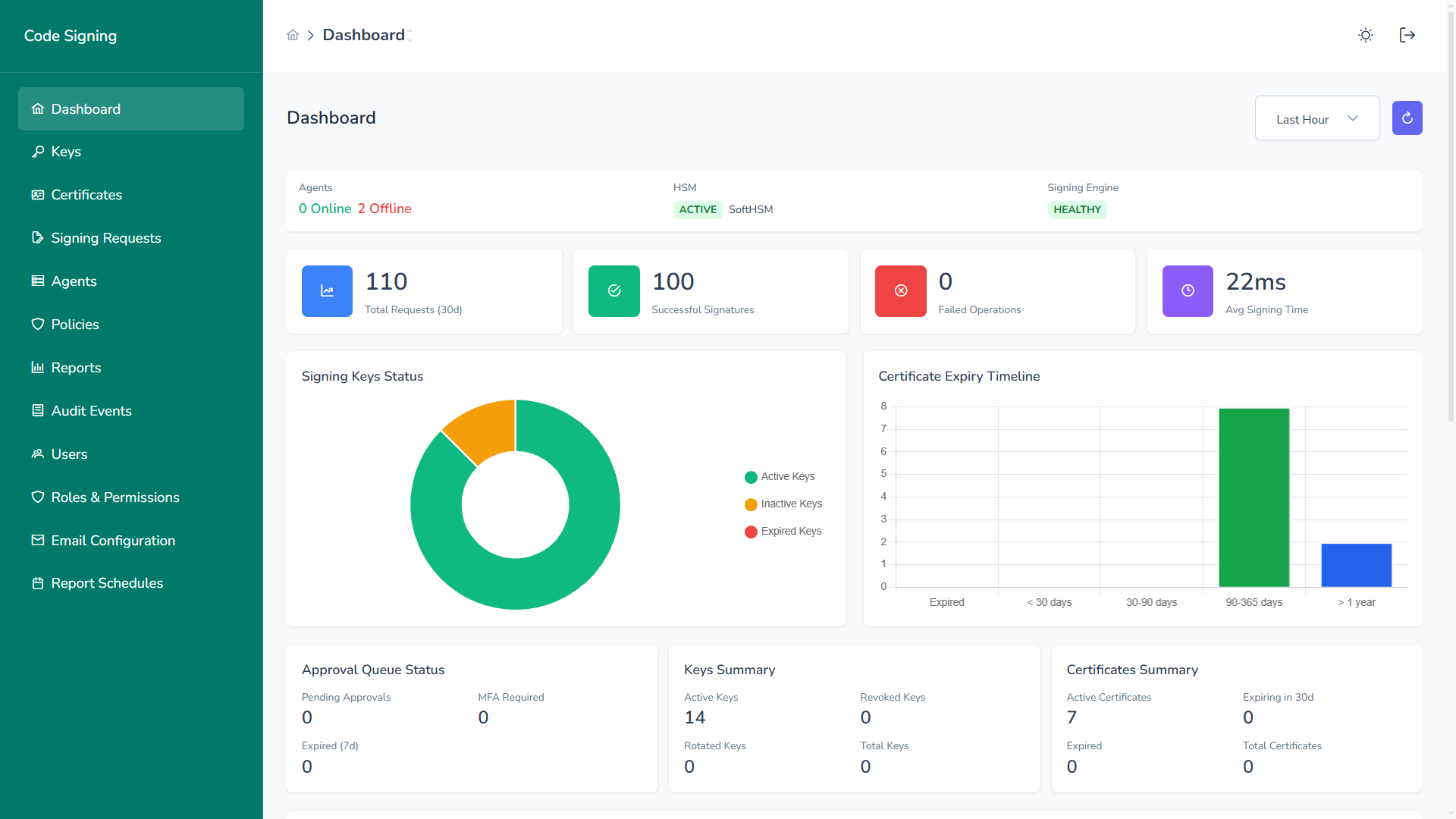
Product Demo
Learn how QCecuring secures your software supply chain with managed code signing workflows and key protection.
As software delivery accelerates across teams, environments, and pipelines, inconsistent signing practices create key misuse risk, weak governance, and poor release traceability.
Different business units, engineering groups, and release pipelines often follow different approval paths and signing practices.
Organizations struggle to prove who signed what, when it was signed, which policy applied, and which key was used.
Approval tickets, isolated tooling, and fragmented workflows add friction without delivering consistent policy enforcement.
Poorly governed keys increase the chance of misuse, overexposure, and release compromise across the software supply chain.
Architecture
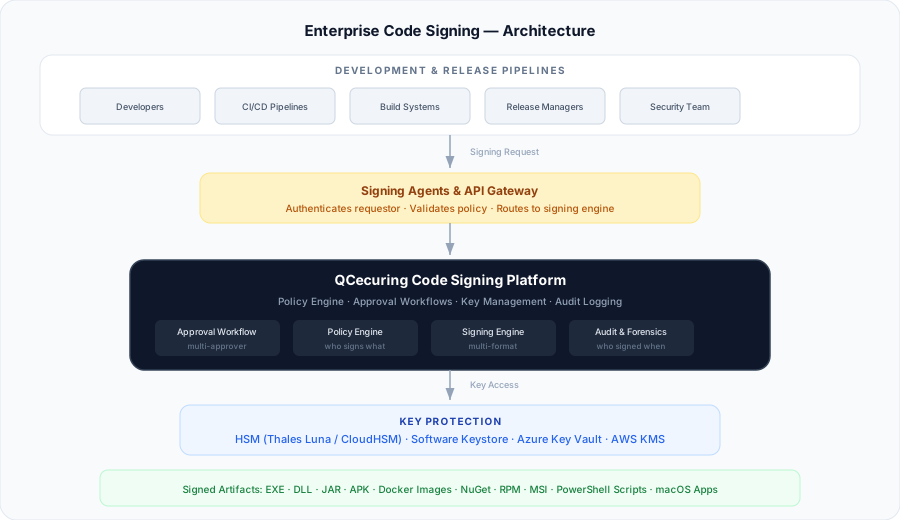
QCecuring helps security, platform, and release engineering teams standardize signing operations, protect signing keys, and enforce policy across enterprise release workflows.
Define approval paths, role boundaries, and signing controls aligned to release criticality, environment sensitivity, and software trust requirements.
Protect signing keys with stronger operational controls, usage restrictions, and monitored access so release trust does not depend on manual discipline.
Capture signing actions, approval decisions, and policy context to improve operational oversight and audit readiness across release environments.
Reduce signing risk, strengthen key governance, and improve release confidence without slowing delivery.
Calculate the cost of ungoverned signing workflows and the ROI of HSM-backed enterprise code signing.
Integrations
QCecuring works with enterprise release tooling so teams can improve signing governance without rebuilding their software delivery stack.
Platform Capabilities
Standardize signing controls across teams, environments, and software release workflows.
Enforce approval paths and role boundaries so no single actor controls the entire signing process.
Reduce exposure of signing keys through stronger operational controls and hardware-backed protection models where required.
Integrate code signing governance into modern software delivery pipelines without disrupting release velocity.
Capture signing events, approvals, and control evidence needed for security reviews, governance, and compliance.
Support SaaS, private, and hybrid deployment approaches based on release and regulatory requirements.
Use Cases
Designed for security teams, release engineering, DevOps, software publishers, and regulated enterprises that need trusted release governance.
Integrate signing policy checks and approvals directly into delivery workflows without introducing unmanaged exceptions.
Apply stricter operational controls so signing trust does not rely on loosely governed credentials.
Maintain consistent signing identity, release integrity, and stronger governance for externally distributed software.
Capture approval evidence, traceability, and policy enforcement records for internal governance and external review.
Replace fragmented signing processes with one repeatable operating model for enterprise software delivery.
Strengthen software release trust with governance-first code signing resources, integrations, and compliance-focused implementation guidance.
Discover our industry-leading solutions, request a demo, or consult with our experts to strengthen your cryptographic operations.
How to implement secure, auditable, and scalable code signing operations for modern software release pipelines.
Code signing has become one of the most important control layers in modern software supply chain security. As organizations deliver software across CI/CD pipelines, cloud-native build systems, artifact repositories, and distributed release teams, the act of signing software is no longer just a technical step near the end of a release process. It is a trust decision with security, governance, and business impact.
QCecuring Code Signing helps organizations centralize signing workflows, protect signing keys, enforce approval policy, and improve traceability across enterprise software release operations. The objective is not only to ensure software authenticity. It is to create a repeatable operating model for trusted software delivery at scale.
Code signing gives software consumers, operating systems, devices, and enterprise environments a way to verify that software came from a trusted source and was not altered after signing. In enterprise environments, this trust model is closely tied to release governance. If code signing is poorly controlled, the problem is not limited to a weak release process. It becomes a software supply chain risk.
When signing controls are fragmented across teams or pipelines, organizations lose visibility into which keys are being used, who approved signing activity, and whether release decisions followed policy. This creates exposure to unauthorized signing, weak accountability, and poor audit readiness. The more software an organization ships, the more important this becomes.
Modern software organizations rarely release through one standardized pipeline. Different teams may use different build systems, CI/CD tools, artifact management processes, signing methods, or approval models. This often results in inconsistent controls. One team may apply strong review and separation of duties, while another uses an overly permissive process because delivery pressure or tool limitations made shortcuts easier.
That inconsistency is where release risk grows. Organizations may not be able to answer simple but critical questions: Who approved this signing action? Which key was used? Was the software signed in the correct environment? Was the artifact checked against policy before signing? Could a developer, release manager, and key user all be the same person? If those answers are unclear, the signing program is not mature enough for enterprise scale.
Signing keys are high-value assets because whoever controls them may be able to sign software that appears legitimate. That makes key exposure one of the most important risks in code signing. Protecting keys is not only about storage. It is also about process. Enterprises need to control when a key can be used, under what conditions, by which roles, and with what level of policy validation.
Stronger code signing governance therefore includes both key protection and workflow control. Hardware-backed protection models such as HSM integration can reduce direct exposure of sensitive key material, but governance still depends on the surrounding workflow. A strong operating model combines protected key usage with approvals, policy checks, traceability, and environment-specific control rules.
Many teams approach code signing as a build pipeline feature rather than a governance program. That mindset creates risk because signing becomes embedded in tooling without enough oversight. In contrast, enterprise-grade code signing should define clear control objectives: which software can be signed, who can request signing, who can approve it, which keys can be used, how criticality is handled, and how evidence is stored.
This governance layer is especially important in organizations with multiple development teams, partner releases, contractor access, or regulated software delivery requirements. It helps prevent signing from becoming a scattered technical step and instead turns it into a controlled trust decision aligned to enterprise security policy.
Policy-driven workflows improve both security and release consistency. Rather than relying on informal team practices, organizations can define rules based on software type, environment, release criticality, and approval needs. High-risk releases can require stronger review, while lower-risk internal workflows may move faster under controlled conditions. The point is not to slow delivery unnecessarily. It is to apply the right level of control to each signing event.
When policy is centralized, security teams gain better visibility into how release trust is enforced across the organization. Engineering teams also benefit because they no longer need to reinvent signing controls within each pipeline. This improves repeatability, reduces ambiguity, and makes the release process easier to scale safely.
Traceability is one of the most undervalued parts of a strong code signing program. Enterprises need more than a record that a binary was signed. They need context. Which request initiated the action? Which team owned the release? Which artifact was approved? Which signing identity was used? Was policy satisfied? Were there exceptions?
Without this context, investigations and audits become slower and less reliable. With it, organizations can answer governance questions faster, support incident response more effectively, and build stronger confidence in their software release process. Traceability also supports internal reviews, executive risk reporting, and external assurance efforts tied to software security posture.
Code signing is not the entire software supply chain security strategy, but it is a foundational part of it. It provides a trust checkpoint between software creation and software distribution. In a world of increasing supply chain scrutiny, the ability to prove that software was signed under controlled conditions has become more important for security teams, customers, and ecosystem partners.
A mature code signing capability also aligns well with broader efforts around build integrity, artifact provenance, release governance, secrets management, and development environment control. It becomes part of a larger release trust model rather than an isolated technical feature.
Most organizations should improve code signing in phases. The first step is standardization: identify which teams sign software, which tools they use, which keys are involved, and where the biggest control gaps exist. The second step is policy definition: establish role boundaries, approval expectations, and signing rules by software and release type. The third step is workflow integration: embed those controls into build and release pipelines. The fourth step is evidence and optimization: improve reporting, measure exceptions, and tighten governance over time.
Enterprise teams should expect more than basic signing capability. A modern code signing platform should improve release trust, reduce key misuse risk, support policy-driven approvals, and strengthen operational visibility across software delivery. It should help organizations move faster without weakening control.
QCecuring Code Signing supports that goal by helping teams centralize signing governance, protect signing keys, improve release traceability, and operationalize trusted software delivery. When implemented well, code signing becomes more than a release checkpoint. It becomes a strategic control for software supply chain security and enterprise release assurance.
Automate certificate discovery, renewal, deployment, and governance across enterprise infrastructure.
Learn more →Discover and inventory every cryptographic asset across your infrastructure.
Learn more →See secure signing workflows, key management, and CI/CD integration in a recorded product walkthrough.
Learn more →Enterprise signing governance vs open-source keyless signing.
Learn more →CA-independent signing governance vs DigiCert ecosystem.
Learn more →Common questions from software security, release engineering, and platform operations teams.
Yes. QCecuring is designed to integrate with existing build and release workflows so organizations can add signing governance without replacing their delivery stack.
No. QCecuring adds secure code signing governance, approval controls, and traceability on top of existing release systems.
QCecuring strengthens operational control over signing keys through policy enforcement, approval rules, and alignment with stronger key protection models such as HSM-backed environments.
Code signing helps verify software authenticity and release integrity. Strong governance around code signing reduces the risk of unauthorized signing, key misuse, and release compromise.
Yes. QCecuring helps capture signing traceability, policy evidence, and approval records that support governance reviews and compliance processes.
Experience how our cryptographic solutions simplify, centralize, and automate identity management for your entire organization.
Get monthly insights on certificate management, post-quantum readiness, and enterprise security. No spam.
We respect your privacy. Unsubscribe anytime.