
Unknown cryptographic assets create hidden exposure
Hardcoded keys in source code, embedded crypto libraries, and untracked certificates across cloud and on-prem environments leave organizations blind to their true cryptographic footprint.
QCecuring's CBOM platform scans your entire infrastructure — source code, certificates, keys, HSMs, cloud services, and network endpoints — to build a complete cryptographic inventory and produce CycloneDX-compliant reports for post-quantum migration readiness.
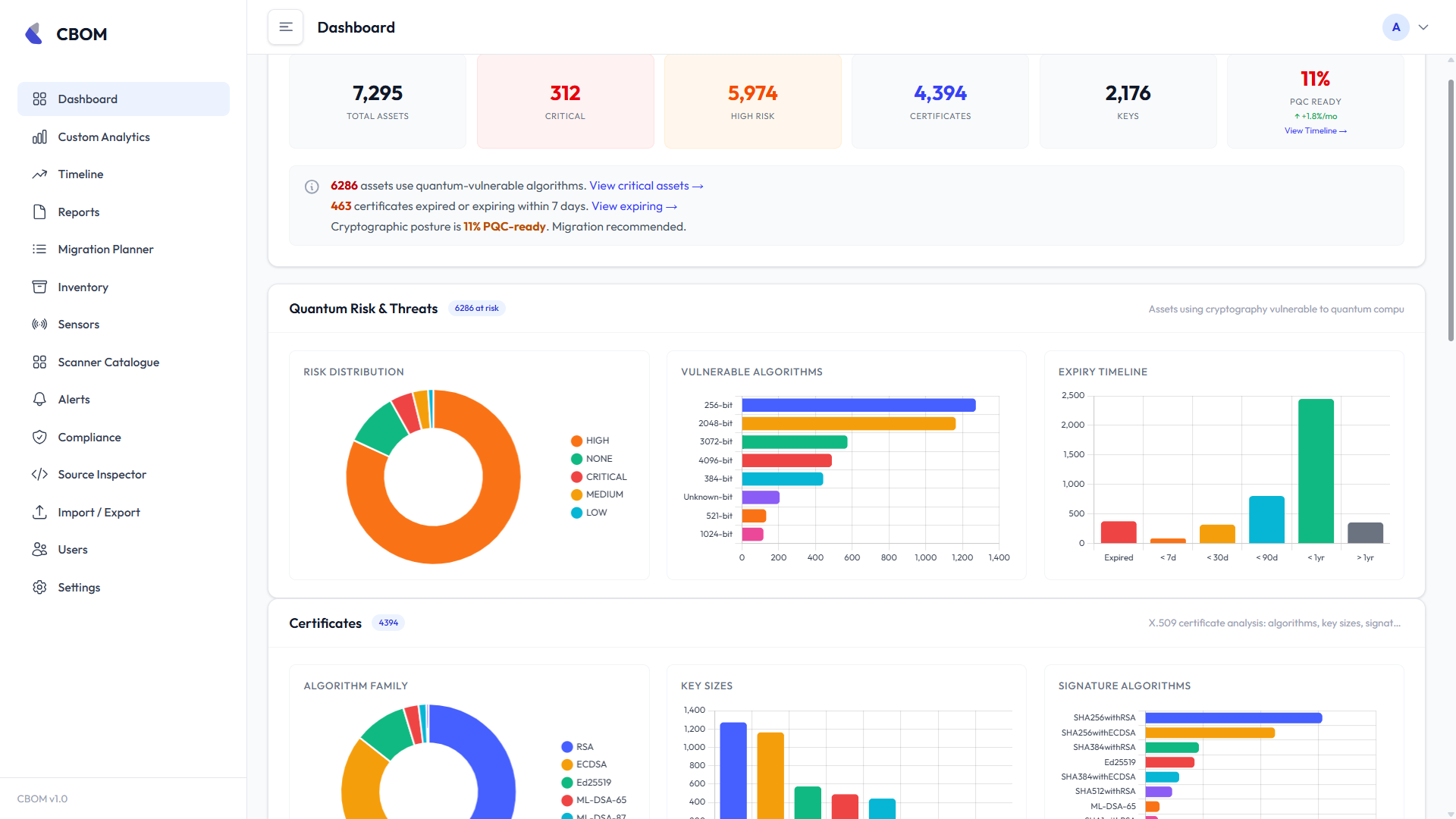
Product Demo
See how QCecuring's CBOM platform discovers cryptographic assets, assesses quantum risk, and generates CycloneDX-compliant inventories across your enterprise.
Cryptographic algorithms, keys, certificates, and protocols are embedded across every layer of enterprise infrastructure — from source code and cloud services to HSMs and container orchestrators. Without a comprehensive inventory, organizations cannot assess quantum risk, plan migrations, or demonstrate compliance. QCecuring's CBOM platform closes this visibility gap.
Hardcoded keys in source code, embedded crypto libraries, and untracked certificates across cloud and on-prem environments leave organizations blind to their true cryptographic footprint.
RSA, ECC, and other asymmetric algorithms are deployed across infrastructure without a systematic way to identify, classify, and prioritize them for post-quantum migration.
Point-in-time assessments and spreadsheet-based tracking cannot keep pace with the volume and distribution of cryptographic assets across modern hybrid environments.
Certificates live in CAs and cloud services, keys reside in HSMs and key stores, and protocol configurations span web servers and network devices — no single view exists today.
Architecture
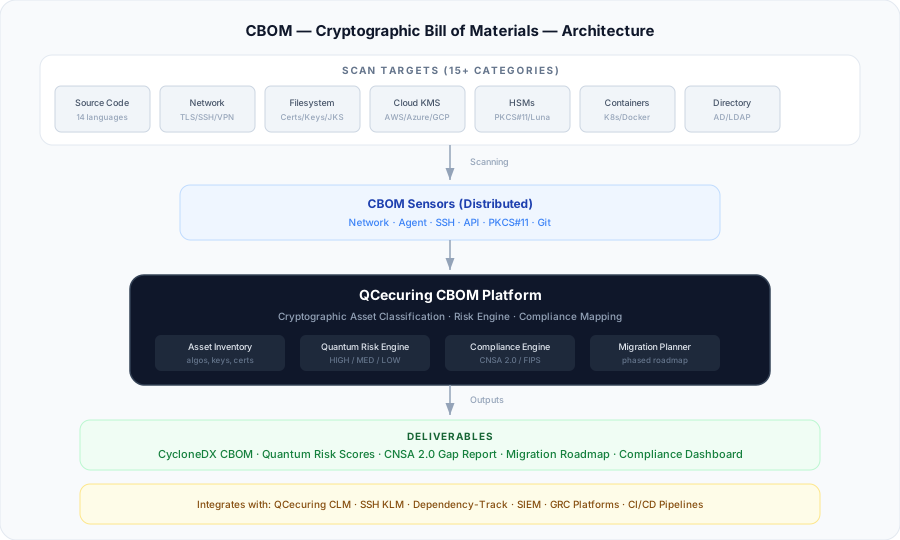
QCecuring CBOM provides security, compliance, and infrastructure teams with a unified platform to discover, classify, and report on every cryptographic asset across the enterprise — the essential first step for post-quantum migration planning.
Scan source code repositories, LDAP and Active Directory, private PKI and certificate authorities, web servers, cloud infrastructure, HSMs and key stores, network devices, Kubernetes clusters, and email systems to build a complete cryptographic inventory.
Classify every discovered cryptographic asset by quantum risk level. RSA and ECC algorithms are flagged as quantum-vulnerable, while AES-256 and SHA-384 are marked as quantum-safe, giving teams a clear migration priority map.
Generate machine-readable Cryptographic Bill of Materials reports in CycloneDX JSON and XML formats for integration with security tooling, compliance workflows, and executive reporting.
Learn how QCecuring's CBOM platform helps your organization discover, classify, and report on every cryptographic asset across your infrastructure.
Quantify the cost of not knowing your cryptographic inventory — emergency migration, compliance penalties, and HNDL risk.
Integrations
QCecuring CBOM integrates with the infrastructure, platforms, and tools where cryptographic assets live — so teams can build a complete inventory without manual discovery or fragmented tooling.
Platform Capabilities
Continuously scan source code, directories, CAs, cloud services, HSMs, network devices, containers, and email systems for cryptographic assets.
Classify discovered algorithms by type, strength, and quantum vulnerability to prioritize migration efforts and track remediation progress.
Produce standards-compliant Cryptographic Bill of Materials reports in machine-readable formats for integration with existing security workflows.
Connect cryptographic inventory data with QCecuring's Certificate Lifecycle Management and SSH Key Lifecycle Management platforms for unified visibility.
Map cryptographic inventory findings to regulatory requirements including NIST SP 800-131A, CNSA 2.0, PCI DSS 4.0, FIPS 140-3, and ISO 27001.
Monitor the transition from quantum-vulnerable to quantum-safe cryptography across the organization with dashboards, milestones, and trend reporting.
Use Cases
Designed for security, compliance, infrastructure, and engineering teams responsible for cryptographic governance and post-quantum readiness.
Build a complete inventory of quantum-vulnerable algorithms and cryptographic assets to create a prioritized, phased migration plan to post-quantum cryptography.
Demonstrate cryptographic governance to auditors and regulators by producing CycloneDX-compliant inventory reports mapped to CNSA 2.0, NIST, and PCI DSS requirements.
Establish a baseline understanding of cryptographic asset distribution, algorithm usage, key strength, and protocol configurations across the enterprise.
Assess the cryptographic posture of acquisition targets by scanning their infrastructure for weak algorithms, expired certificates, and quantum-vulnerable deployments.
Embed cryptographic asset scanning into CI/CD pipelines to detect hardcoded keys, weak algorithms, and non-compliant cryptographic usage before code reaches production.
Deepen your understanding of cryptographic asset discovery, CBOM standards, and post-quantum migration planning.
Discover our industry-leading solutions, request a demo, or consult with our experts to strengthen your cryptographic operations.
How security, compliance, and infrastructure teams can build a complete cryptographic inventory to assess quantum risk, demonstrate regulatory compliance, and plan post-quantum migration.
Cryptographic assets are embedded across every layer of modern enterprise infrastructure. Algorithms encrypt data in transit and at rest. Keys authenticate services, sign code, and protect secrets. Certificates establish trust between systems, users, and devices. Protocols govern how cryptographic operations are negotiated and executed. Yet most organizations have no comprehensive inventory of these assets — no single view of what cryptography is deployed, where it runs, which algorithms are in use, and which assets are vulnerable to quantum computing threats.
This visibility gap is becoming a strategic risk. Regulatory bodies, industry standards organizations, and national security agencies are setting deadlines for post-quantum cryptographic migration. NIST has finalized its first set of post-quantum algorithms. The NSA's CNSA 2.0 guidance establishes timelines for transitioning national security systems. PCI DSS 4.0 introduces stronger cryptographic requirements for payment infrastructure. Organizations that cannot inventory their cryptographic assets cannot plan, prioritize, or execute these transitions.
QCecuring's Cryptographic Bill of Materials (CBOM) platform closes this gap. CBOM provides automated discovery, classification, and reporting of cryptographic assets across the enterprise — producing CycloneDX-compliant reports that integrate with existing security tooling and compliance workflows.
Post-quantum migration is not a single project. It is a multi-year transformation that touches every system, application, and service that uses cryptography. Before organizations can migrate, they need to answer fundamental questions: What algorithms are deployed? Where are quantum-vulnerable keys and certificates? Which systems depend on RSA or ECC? What is the blast radius if a specific algorithm is deprecated?
Without a cryptographic inventory, these questions cannot be answered systematically. Teams resort to manual audits, spreadsheet tracking, and tribal knowledge — approaches that are incomplete by design. They miss hardcoded keys in source code, embedded crypto libraries in third-party dependencies, certificates issued by shadow CAs, and protocol configurations buried in network device firmware.
CBOM automates this discovery process. By scanning across infrastructure types — source code, directories, certificate authorities, cloud services, HSMs, network devices, containers, and email systems — CBOM builds a continuously updated inventory that serves as the foundation for migration planning, compliance reporting, and risk assessment.
Cryptographic assets do not live in one place. They are distributed across the technology stack, managed by different teams, and governed by different policies. A comprehensive CBOM platform needs to scan across all of these domains to build a complete picture.
Source code repositories: Hardcoded keys, embedded cryptographic libraries, algorithm usage patterns, and key generation logic are common in application code. CBOM scans repositories to identify these assets and flag non-compliant or quantum-vulnerable implementations.
LDAP and Active Directory: Directory services store certificates, key material, and authentication credentials. CBOM queries these directories to discover cryptographic assets used for identity, authentication, and access control.
Private PKI and certificate authorities: Internal CAs issue certificates for services, devices, and users. CBOM inventories all issued certificates, map CA hierarchies, and identify certificates using weak or quantum-vulnerable algorithms.
Web servers and endpoints: TLS certificates, cipher suite configurations, and protocol settings on web servers and API endpoints represent a significant portion of an organization's cryptographic footprint. CBOM scans these endpoints to catalog certificate details and protocol configurations.
Cloud infrastructure: AWS ACM, GCP Certificate Manager, Azure Key Vault, and CloudHSM services manage certificates and keys in cloud environments. CBOM integrates with these services to discover and inventory cloud-managed cryptographic assets.
HSMs and key stores: Hardware security modules from vendors like Thales Luna, Entrust nShield, and AWS CloudHSM protect the most sensitive cryptographic material. CBOM inventories key material stored in these devices to ensure complete visibility.
Network infrastructure: VPN certificates, load balancer certificates, and firewall certificates are often managed separately from application certificates. CBOM scans network devices to discover these assets and include them in the cryptographic inventory.
Containers and orchestrators: Kubernetes secrets, service mesh mTLS certificates, and container-level cryptographic configurations are increasingly common in modern architectures. CBOM scans container environments to discover these assets.
Email systems: S/MIME certificates and PGP keys used for email encryption and signing represent another category of cryptographic assets that organizations need to inventory. CBOM discovers these assets across email infrastructure.
Discovery alone is not enough. Once cryptographic assets are inventoried, they need to be classified by quantum risk. Not all algorithms are equally vulnerable. RSA and ECC-based algorithms are considered quantum-vulnerable because Shor's algorithm running on a sufficiently powerful quantum computer could break them. Symmetric algorithms like AES-256 and hash functions like SHA-384 are considered quantum-safe at current key lengths, though they may require larger key sizes.
CBOM classifies every discovered asset into risk categories: quantum-vulnerable, quantum-safe, or unknown. This classification gives security and compliance teams a clear map of where migration effort is needed, which systems are highest priority, and where quantum-safe algorithms are already in use. The classification also supports compliance reporting — organizations can demonstrate to auditors and regulators exactly what percentage of their cryptographic footprint has been assessed and what migration progress has been made.
The CycloneDX standard, maintained by OWASP, provides a structured format for documenting software, hardware, and cryptographic components. A CycloneDX CBOM report includes details about each cryptographic asset: the algorithm, key length, certificate details, protocol version, location, owner, and quantum vulnerability classification.
CBOM generates reports in both CycloneDX JSON and XML formats. These machine-readable reports can be consumed by SIEM platforms, GRC tools, security orchestration systems, and compliance workflows. They can also be shared with auditors, regulators, and business partners as evidence of cryptographic governance.
The CycloneDX format is becoming the de facto standard for cryptographic inventory reporting. By producing CycloneDX-compliant output, CBOM ensures that organizations can integrate cryptographic visibility into their existing security and compliance ecosystems without custom tooling or manual translation.
Post-quantum migration follows a predictable lifecycle: discover, assess, plan, migrate, and verify. CBOM supports the first three phases — and provides ongoing monitoring through the migration and verification phases.
Discover: Build a complete inventory of all cryptographic assets across the enterprise. This is the foundation that every subsequent phase depends on.
Assess: Classify assets by quantum vulnerability, map them to compliance requirements, and identify the highest-risk systems and algorithms.
Plan: Use the classified inventory to create a prioritized migration plan. Determine which systems should migrate first, which algorithms should be replaced, and what the expected timeline and resource requirements are.
Migrate: Execute the migration plan while using CBOM to track progress. As algorithms are replaced and certificates are reissued, CBOM updates the inventory to reflect the current state.
Verify: After migration, use CBOM to verify that quantum-vulnerable assets have been remediated and that the organization's cryptographic posture meets compliance requirements.
Regulatory and industry frameworks are increasingly requiring organizations to demonstrate cryptographic governance. CBOM maps inventory findings to specific framework requirements, making it easier for compliance teams to produce evidence and track gaps.
NIST SP 800-131A: Provides guidance on transitioning cryptographic algorithms and key lengths. CBOM identifies assets that do not meet NIST's recommended minimums and flags them for remediation.
CNSA 2.0: The NSA's Commercial National Security Algorithm Suite 2.0 establishes timelines for transitioning to quantum-resistant algorithms. CBOM classifies assets against CNSA 2.0 requirements and tracks migration progress.
PCI DSS 4.0: Introduces stronger requirements for cryptographic key management and algorithm usage in payment environments. CBOM helps payment organizations inventory and assess their cryptographic assets against PCI DSS 4.0 controls.
FIPS 140-3: Defines security requirements for cryptographic modules. CBOM identifies which HSMs, key stores, and cryptographic implementations are FIPS-validated and which require attention.
ISO 27001: Requires organizations to manage cryptographic controls as part of their information security management system. CBOM provides the inventory evidence needed to demonstrate compliance with ISO 27001 cryptographic control objectives.
CBOM is designed to complement QCecuring's existing Certificate Lifecycle Management (CLM) and SSH Key Lifecycle Management (SSH KLM) platforms. While CLM manages the lifecycle of certificates and SSH KLM manages SSH keys, CBOM provides the broader cryptographic visibility layer that encompasses all cryptographic assets — not just certificates and SSH keys.
This integration means that organizations using QCecuring's platform can see their complete cryptographic posture from a single operational view. Certificate data from CLM, SSH key data from SSH KLM, and algorithm, protocol, and key data from CBOM come together to provide unified visibility, risk assessment, and compliance reporting.
Organizations do not need to scan everything on day one. A practical approach starts with the highest-value, highest-risk infrastructure and expands from there.
Each phase produces measurable outcomes: a larger inventory, better risk classification, and stronger compliance evidence. This phased approach helps organizations demonstrate progress to leadership and regulators while building toward comprehensive cryptographic visibility.
For enterprise security and compliance leaders, the goal is not simply to produce a one-time inventory. The goal is to establish a continuous, automated process for cryptographic asset discovery, classification, and governance. That process should improve quantum readiness, reduce compliance burden, and give the organization a clear path to post-quantum migration.
QCecuring's CBOM platform supports that goal by providing automated discovery across infrastructure types, quantum vulnerability classification, CycloneDX-compliant reporting, compliance framework mapping, and integration with QCecuring's existing CLM and SSH KLM platforms. CBOM gives organizations the cryptographic visibility they need to make informed decisions about their post-quantum future.
Automate certificate discovery, issuance, renewal, and governance across public and private CAs.
Learn more →Control and secure SSH access across cloud, on-prem, and distributed environments.
Learn more →Prepare your cryptographic infrastructure for post-quantum algorithm transitions and crypto-agility.
Learn more →Protect software integrity with enterprise code signing and key management.
Learn more →Why a software bill of materials doesn't cover cryptographic risk.
Learn more →Full infrastructure crypto discovery vs application-level analysis.
Learn more →Standalone CBOM vs integrated Keyfactor crypto discovery.
Learn more →Why spreadsheet-based crypto inventories fail at scale.
Learn more →Common questions from security, compliance, infrastructure, and engineering teams about cryptographic asset discovery and CBOM.
A CBOM is a structured inventory of all cryptographic assets in an organization — including algorithms, keys, certificates, protocols, and cryptographic libraries. It provides a complete view of where and how cryptography is used across infrastructure, applications, and services.
CycloneDX is an OWASP open standard for software, hardware, and cryptographic bills of materials. QCecuring CBOM produces reports in CycloneDX JSON and XML formats, enabling integration with existing security tooling and compliance workflows.
CBOM is designed to scan source code repositories, LDAP and Active Directory, private PKI and certificate authorities, web servers and endpoints, cloud infrastructure (AWS, Azure, GCP), HSMs and key stores, network devices, Kubernetes clusters, and email systems.
CBOM classifies every discovered cryptographic asset by quantum vulnerability. This classification gives teams a clear map of which algorithms need to be migrated to post-quantum alternatives, enabling prioritized and phased migration planning.
Yes, CBOM is available now. Contact us to schedule a demo, discuss your cryptographic inventory needs, or start a pilot deployment for your organization.
CBOM is designed to integrate with QCecuring's Certificate Lifecycle Management and SSH Key Lifecycle Management platforms, providing unified cryptographic visibility across certificates, keys, and algorithms from a single operational view.
Snyk and Trivy find vulnerable dependencies in code. They do not scan network endpoints, HSMs, LDAP, certificate stores, web server configs, or cloud KMS for cryptographic material. CBOM scans 15+ infrastructure categories including source code, filesystems, cloud services, and hardware — producing a comprehensive cryptographic inventory, not just dependency alerts.
SBOMs inventory software components and libraries. CBOMs specifically inventory cryptographic primitives — algorithms, key sizes, certificate chains, protocol configurations, and key storage locations. A SBOM tells you which crypto library is linked. A CBOM tells you which algorithms are actually used, where keys reside, and which assets are quantum-vulnerable.
The threat is Harvest Now, Decrypt Later (HNDL). Adversaries collecting encrypted data today can decrypt it once quantum computers are available. If your organization handles data that must remain confidential for 5-10+ years (financial records, health data, government communications), the migration timeline starts now. CNSA 2.0 mandates PQC adoption beginning 2025-2030.
Manual audits miss embedded cryptography, catch only point-in-time state, and cannot scale across modern infrastructure. CBOM automates continuous discovery across source code, network, cloud, containers, HSMs, and certificate stores — finding cryptographic assets that manual processes consistently miss.
Experience how our cryptographic solutions simplify, centralize, and automate identity management for your entire organization.
Get monthly insights on certificate management, post-quantum readiness, and enterprise security. No spam.
We respect your privacy. Unsubscribe anytime.