
AppViewX started life as a network automation company in 2008. Their original product automated F5, Citrix, and Cisco device configurations — load balancer rules, firewall policies, DNS changes. Certificate management came later, built on top of that network automation foundation. This heritage gives AppViewX a unique angle: they don’t just manage certificates, they manage the network infrastructure those certificates live on.
In 2026, AppViewX has rebranded their product suite as “AVX ONE” — a platform covering CLM, PKI-as-a-Service, Kubernetes certificates, code signing, SSH, and ADC automation. They’ve raised $52 million from Brighton Park Capital, acquired Eos (for enhanced discovery), and positioned themselves as the “crypto-agility” platform with features like Crypto Resilience Scorecards and a Quantum Trust Hub.
The question for buyers: do you need a network automation platform that also does CLM, or a purpose-built CLM platform? That’s the core of this comparison.
Company Backgrounds
AppViewX
AppViewX was founded in 2008 by Anand Purusothaman in New York. For its first decade, it was primarily a network automation and orchestration company — automating ADC (Application Delivery Controller) configurations across F5 BIG-IP, Citrix NetScaler, and other network devices.
Certificate lifecycle management was added as the company recognized that certificate operations were a major pain point for the same network teams they already served. The CERT+ product (now AVX ONE CLM) grew from this network-centric worldview.
Key facts:
- Founded: 2008, New York (with engineering in India)
- Funding: $52M total (Series A: $30M from Brighton Park Capital, 2019; Series B: 2022)
- Products: AVX ONE CLM, AVX ONE PKIaaS, AVX ONE Kubernetes, AVX ONE Code Signing, AVX ONE SSH, AVX ONE ADC
- Heritage: Network automation → certificate management
- Acquired: Eos (discovery capabilities)
- Differentiators: ADC automation, Crypto Resilience Scorecards, Quantum Trust Hub
- Target: Large enterprise, Fortune 500, network-heavy environments
The network automation heritage matters. AppViewX’s deepest integrations are with network devices — F5, Citrix, A10, Palo Alto, Cisco. If your certificate pain is primarily on load balancers and network appliances, AppViewX understands that world better than pure CLM vendors.
QCecuring
QCecuring is an enterprise cryptographic security company focused on making certificate and key management accessible beyond the Fortune 500. Built cloud-native from the ground up with modern architecture (Spring Boot + MongoDB + Angular), it covers the full cryptographic lifecycle.
Key facts:
- Modern architecture: Single JAR deployment, any OS
- Products: SSL CLM, SSH KLM, Code Signing, PKI-aaS, HSM-aaS, CBOM
- Focus: Mid-market to enterprise, government, MSPs
- Differentiators: CBOM (native), deployment simplicity, CA-agnostic, cost-effective
- No network automation heritage — pure certificate/key management focus
Architecture Comparison
| Component | QCecuring | AppViewX AVX ONE |
|---|---|---|
| Backend | Spring Boot 3.5 (embedded server) | Java-based microservices |
| Database | MongoDB | MongoDB + PostgreSQL |
| Deployment | Single JAR, Docker, K8s | Multi-component (platform + agents) |
| OS requirement | Any (Linux, Windows, macOS, Docker) | Linux (CentOS/RHEL recommended) |
| Agent model | Lightweight agent with mTLS | AppViewX agents + network connectors |
| Cloud deployment | SaaS or self-hosted | SaaS or self-hosted |
| HA model | Container orchestration | Clustered deployment |
| API | REST (OpenAPI) | REST API |
| UI | Angular 17+ (modern SPA) | Web UI (workflow-driven) |
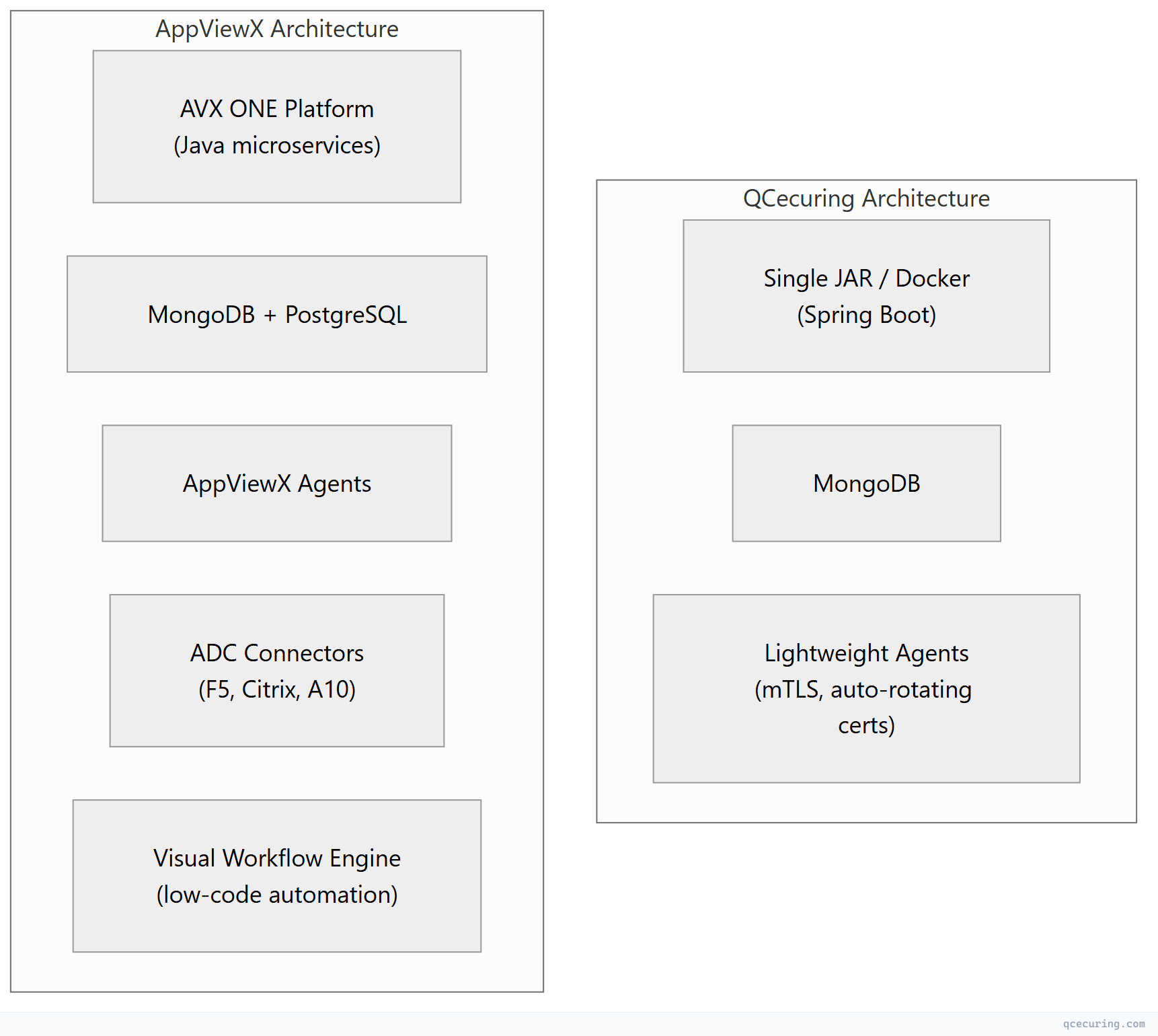
AppViewX’s visual workflow engine is a distinctive feature. It provides a drag-and-drop interface for building certificate automation workflows — useful for teams that want to customize automation without writing code. QCecuring takes a more configuration-driven approach with policy rules rather than visual workflows.
Feature-by-Feature Comparison
Discovery
| Capability | QCecuring | AppViewX AVX ONE |
|---|---|---|
| Network port scanning | Yes (7 methods) | Yes (“Smart Discovery”) |
| Cloud API (AWS, Azure, GCP) | Yes (native) | Yes |
| AD CS discovery | Yes | Yes |
| Kubernetes/cert-manager | Roadmap | Yes (AVX ONE Kubernetes) |
| Certificate Transparency logs | Yes | Yes |
| Network device certificates | Yes | Yes (deep — ADC heritage) |
| Continuous scanning | Yes | Yes |
| CBOM (cryptographic inventory) | Yes (core feature) | Partial (Crypto Resilience Scorecards) |
AppViewX’s “Smart Discovery” is their branded discovery engine that combines network scanning with their ADC connector knowledge — it knows where certificates live on F5 virtual servers, Citrix vServers, and similar network constructs. This is deeper than generic port scanning for network-heavy environments.
Automation & Lifecycle
| Capability | QCecuring | AppViewX AVX ONE |
|---|---|---|
| ACME protocol | Yes (full v2) | Yes |
| AD CS auto-enrollment | Yes | Yes |
| SCEP/EST for devices | Yes | Yes |
| Zero-touch renewal | Yes | Yes (“Closed-Loop Automation”) |
| Visual workflow builder | No (policy-driven) | Yes (low-code drag-and-drop) |
| ADC certificate deployment | Roadmap | Yes (market-leading — F5, Citrix, A10, Palo Alto) |
| Load balancer automation | Roadmap | Yes (deep — their heritage) |
| Cloud service deployment | Yes | Yes |
| Approval workflows | Yes (multi-level) | Yes |
| Self-service portal | Yes | Yes |
Network Device & ADC Integration
This is AppViewX’s strongest differentiator:
| ADC/Network Device | QCecuring | AppViewX |
|---|---|---|
| F5 BIG-IP | Roadmap | Deep (certificate + VIP + pool management) |
| Citrix ADC / NetScaler | Roadmap | Deep (certificate + binding automation) |
| A10 Networks | Roadmap | Yes |
| Palo Alto firewalls | Roadmap | Yes |
| Cisco ACE/ASA | No | Yes |
| AWS ALB/NLB/CloudFront | Yes | Yes |
| Azure Application Gateway | Yes | Yes |
| Nginx/Apache/IIS | Yes | Yes |
| HAProxy | Yes | Limited |
If your primary certificate pain is on network appliances — certificates expiring on F5 virtual servers, Citrix bindings breaking, firewall certificate rotation — AppViewX has 15+ years of network automation expertise here. QCecuring covers web servers and cloud services well but doesn’t yet match AppViewX’s ADC depth.
Post-Quantum & Crypto Agility
| Capability | QCecuring | AppViewX |
|---|---|---|
| CBOM (full cryptographic inventory) | Yes (core product) | Partial (“Crypto Resilience Scorecards”) |
| PQC algorithm inventory | Yes | Yes (“Quantum Trust Hub”) |
| Crypto-agility assessment | Yes (built-in) | Yes (Crypto Resilience Scorecards) |
| PQC migration planning | Yes | Yes (Quantum Trust Hub) |
| Risk scoring | Yes | Yes (scorecards with risk ratings) |
Both platforms have invested in PQC readiness, but with different approaches. AppViewX’s “Crypto Resilience Scorecards” provide a risk-scoring view of your cryptographic posture. QCecuring’s CBOM provides a deeper, standards-aligned cryptographic inventory (CycloneDX CBOM format).
PKI Capabilities
| Capability | QCecuring | AppViewX |
|---|---|---|
| Built-in CA | No (CA-agnostic) | Yes (AVX ONE PKIaaS) |
| PKI-as-a-Service | No | Yes (AppViewX-hosted CA) |
| CA-agnostic orchestration | Yes (any CA) | Yes (any CA) |
| Kubernetes cert issuance | Roadmap | Yes (AVX ONE Kubernetes) |
| Code signing | Separate product | Yes (AVX ONE Code Signing) |
| SSH management | Separate product | Yes (AVX ONE SSH) |
AppViewX offers a broader product suite under one platform — CLM, PKI, Kubernetes, code signing, SSH, and ADC automation all in AVX ONE. QCecuring offers these as separate products that can be combined.
Where QCecuring Wins
1. Deployment Simplicity
AppViewX AVX ONE is a multi-component platform that requires careful infrastructure planning — platform servers, database servers, agents, and connectors. QCecuring is a single JAR file.
| QCecuring | AppViewX | |
|---|---|---|
| Time to first value | Hours to days | 2-6 weeks |
| Infrastructure | Single process, any OS | Multi-component, Linux recommended |
| Professional services | Not required | Typically recommended |
| Ongoing complexity | Minimal | Multiple components to maintain |
2. Cost
AppViewX targets Fortune 500 enterprises with pricing to match. Their platform licensing, professional services, and infrastructure requirements put the total cost well above what mid-market organizations can justify.
QCecuring delivers core CLM capabilities at a fraction of the cost — no mandatory professional services, no complex infrastructure, no per-module licensing that adds up.
3. Pure CLM Focus
AppViewX’s heritage is network automation. Their platform does many things — ADC automation, DNS management, certificate management, PKI, code signing. This breadth means the CLM component is one module among many, not the sole focus.
QCecuring is purpose-built for certificate and key management. Every feature, every UX decision, every integration is designed for the certificate lifecycle use case. There’s no ADC automation complexity to navigate if you just need CLM.
4. CBOM Depth
QCecuring’s CBOM is a standards-aligned (CycloneDX) cryptographic inventory that maps every algorithm, key, and certificate to compliance requirements and PQC migration readiness. AppViewX’s Crypto Resilience Scorecards provide a risk view but aren’t as deep or standards-aligned for regulatory evidence.
5. Air-Gapped / Sovereign Deployment
QCecuring’s single-JAR architecture makes air-gapped deployment trivial. AppViewX’s multi-component architecture requires more planning for disconnected environments.
Where AppViewX Wins
1. Network Device Automation (ADC)
This is AppViewX’s killer feature. If you manage hundreds of F5 virtual servers, Citrix vServers, or Palo Alto firewall certificates, AppViewX doesn’t just renew the certificate — it handles the full deployment workflow: upload cert to device, bind to virtual server, verify traffic is flowing, rollback if something breaks.
No other CLM vendor matches this depth for network appliance automation. It’s 15 years of network automation expertise baked into the product.
2. Visual Workflow Engine
AppViewX’s low-code workflow builder lets teams create custom automation without writing scripts. Drag-and-drop steps: “discover cert → check expiry → request renewal → deploy to F5 → verify binding → notify team.” This is powerful for organizations with complex, multi-step certificate operations that don’t fit standard automation templates.
3. Broader Platform (One Vendor for Everything)
AVX ONE covers CLM, PKI-as-a-Service, Kubernetes certificates, code signing, SSH, and ADC automation in one platform. If you want a single vendor for all machine identity operations plus network automation, AppViewX provides that consolidation.
4. Kubernetes-Native Module
AVX ONE Kubernetes provides dedicated certificate management for container environments — not just cert-manager integration but a purpose-built module for Kubernetes certificate operations, policy enforcement, and visibility.
5. Crypto Resilience Scorecards
AppViewX’s risk-scoring approach gives CISOs a dashboard view of cryptographic posture — which systems are at risk, what algorithms are weak, where PQC migration is needed. It’s a compelling executive-level view that QCecuring’s more technical CBOM approach doesn’t match for board presentations.
Pricing Comparison
| QCecuring | AppViewX | |
|---|---|---|
| Pricing model | Platform license (competitive) | Per-module + platform fee |
| Entry point | Lower (mid-market accessible) | Higher (enterprise minimum) |
| ADC module | N/A | Additional cost |
| PKIaaS module | N/A | Additional cost |
| Professional services | Optional | Typically recommended ($50K+) |
| Infrastructure | Minimal (single process) | Multi-component (servers + DB) |
| Year 1 TCO (mid-market) | $$ | $$$-$$$$ |
Decision Framework
| If You… | Choose |
|---|---|
| Have heavy F5/Citrix/network device infrastructure | AppViewX |
| Need visual workflow automation (low-code) | AppViewX |
| Want one platform for CLM + ADC + PKI + SSH | AppViewX |
| Need Kubernetes-native certificate management | AppViewX |
| Need fast deployment without complex infrastructure | QCecuring |
| Are mid-market with budget constraints | QCecuring |
| Need deep CBOM for compliance/PQC planning | QCecuring |
| Want pure CLM without network automation complexity | QCecuring |
| Need air-gapped/sovereign deployment | QCecuring |
| Are an MSP managing multiple clients | QCecuring |
| Want CA-agnostic with no vendor CA bias | QCecuring |
| Need EU compliance mapping (DORA, CRA) | QCecuring |
FAQ
Q: Is AppViewX overkill if I just need certificate management?
Potentially. AppViewX’s strength is the breadth of their platform — CLM + ADC + PKI + SSH + code signing. If you only need CLM (discovery, monitoring, renewal), you’re paying for capabilities you won’t use. QCecuring’s focused CLM approach may be more cost-effective for pure certificate lifecycle needs.
Q: Can AppViewX replace my F5 management tools?
Partially. AppViewX automates certificate operations on F5 (and other ADCs) but doesn’t replace F5’s own management tools for non-certificate operations (pool management, iRules, etc.). It’s a certificate-focused automation layer on top of your existing ADC management.
Q: Which has better PQC readiness?
Both have invested here. AppViewX’s Quantum Trust Hub and Crypto Resilience Scorecards provide executive-friendly risk views. QCecuring’s CBOM provides deeper, standards-aligned cryptographic inventory. For regulatory evidence (DORA, CNSA 2.0), QCecuring’s approach is more audit-ready. For CISO dashboards, AppViewX’s scorecards are more visual.
Q: Does AppViewX work well for cloud-native environments?
Yes — AVX ONE Kubernetes is purpose-built for container environments. But AppViewX’s heritage is network devices, not cloud-native. If your environment is primarily Kubernetes/cloud with minimal network appliances, QCecuring or cert-manager may be simpler fits.
Q: Can I start with one AppViewX module and add more later?
Yes, AVX ONE is modular. You can start with CLM and add PKIaaS, Kubernetes, or ADC modules later. But the platform infrastructure is the same regardless of modules — you’re deploying the full platform even if you only use one module initially.
Q: How do implementation timelines compare?
QCecuring: hours to days for basic deployment, 2-4 weeks for full production. AppViewX: 4-8 weeks typical, longer for complex ADC integrations. AppViewX’s professional services engagement adds value for network-heavy environments but extends the timeline.
Related Reading: